The use of MPO cable and MTP cable is growing increasingly common in 40/100G, even 200/400G data center networks. While both are widely used fiber optic patch cord types, they do have some differences. Understanding the differences are critical for efficient network deployment. This article delves into the key disparities between of MPO cable and MTP cable.
What Is MPO Cable and MTP Cable?
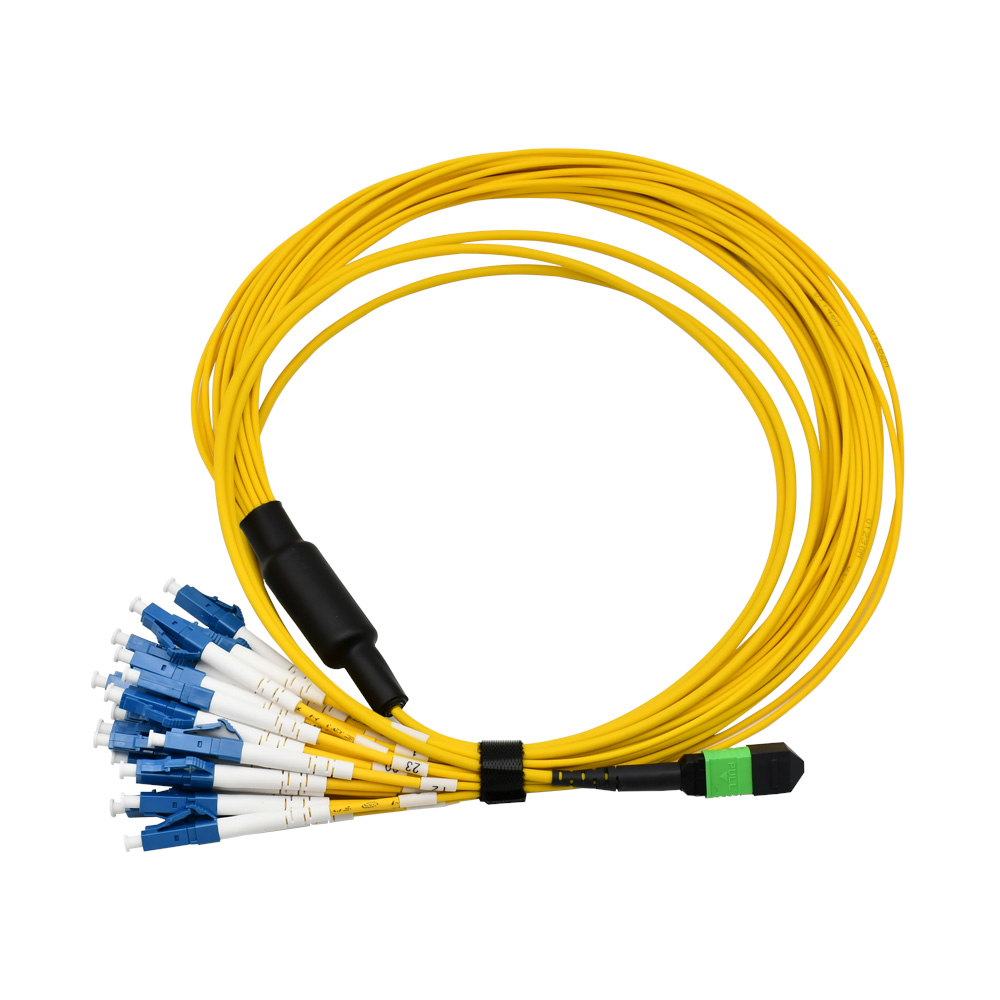
MPO cable is equipped with MPO connectors on both ends. MPO fiber connectors are designed to provide multi-fiber connections through one connector to support high density cabling system. MPO connectors comply with the IEC 61754-7 standard and the US TIA-604-5 standard. Currently, MPO cable are usually equipped with 8, 12, 16 or 24 fibers for common data center and LAN applications, and in large optical switches, they can also be equipped with 32, 48, 60, 72 fibers for special ultra high density multi fiber arrays.
MTP® cable is equipped with MTP® fiber connectors on both ends. MTP® connector is a trademark registered by US Conec for an improved specification version of the MPO connector. Therefore, the MTP® connector fully complies with all common MPO connector requirements and can be directly interconnected with other MPO-based infrastructures. However, the MTP® connector is a multi-engineered product enhancement that improves mechanical and optical performance compared to general purpose MPO connectors.
What Are the Differences Between MTP® vs MPO Cable?
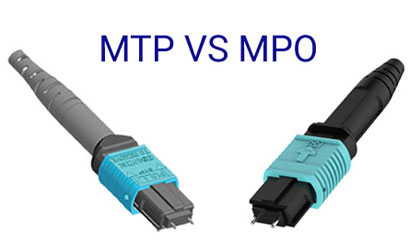
The key difference between MTP® cable and MPO cable is their fiber optic connectors. As an improved version, MTP® fiber cable equipped with MTP® connectors have better mechanical design and optical performance.
MTP® vs. MPO Cable: Mechanical Design
Pin Clamp
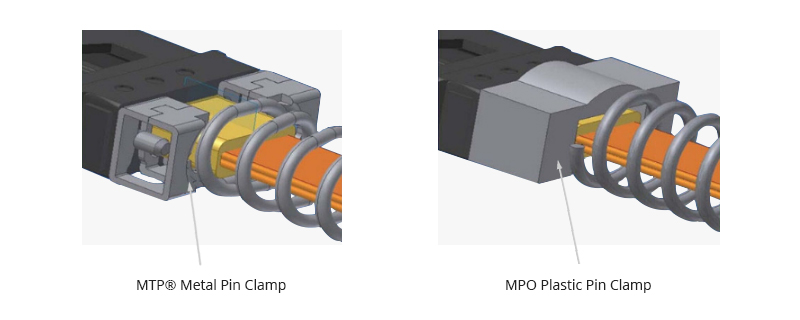
MPO connector is usually equipped with inferior plastic pin clamps, which may lead to effortless breaking of pins with constant cable mating, while the MTP® connector has a metal pin clamp to ensure a strong clasp on the pins and minimize any inadvertent breaking when mating connectors. In MTP® connectors, oval springs are used to maximize the gap between the fiber ribbon and the spring, which can protect the fiber ribbon from damage during the insertion process. The MTP® cable design includes recessed pin clips and oval springs, which ensure a firm spring seat and a larger gap between the spring and the ribbon cable to reduce the risk of MTP® cable damage.
Floating Ferrules
Floating ferrules are used in MTP® optical cable to improve mechanical performance. In other words, the floating ferrule of the MTP® connector can float internally to maintain physical contact of the mated pair under applied loads. However, MPO fiber optic connectors are not manufactured with floating ferrules. The floating ferrule feature is particularly important for applications where the fiber optic cable is directly plugged into active Tx/Rx devices and is one of the main reasons why MTP® connectors are an ideal choice for emerging parallel optics Tx/Rx applications.
Guide Pins
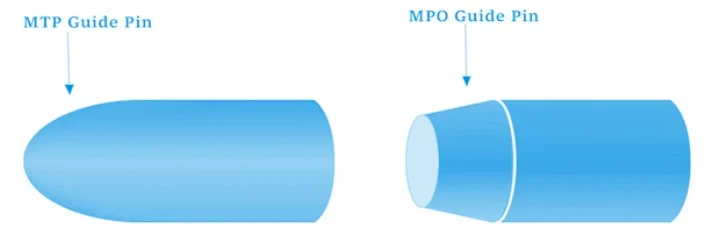
The guide pins are critical for precise alignment when mating two MT ferrules. Guide pins used in MTP® and MPO connectors are also different. MTP® connectors use tightly-toleranced stainless steel oval guide pin tips to reduce the amount of debris that can fall into the guide pin holes or onto the ferrule endface. However, the chamfered guide pins used in MPO connectors generate more debris during use.
Removable Shell of MTP® Cable
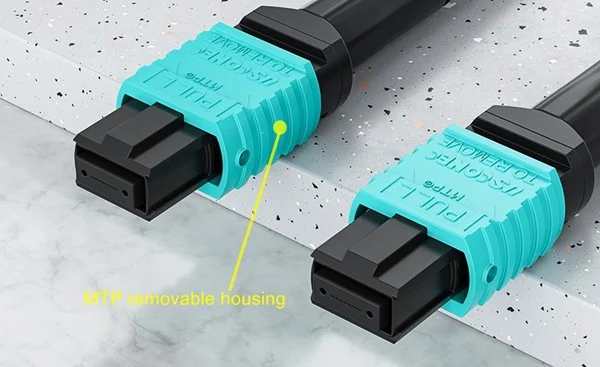
When comparing MTP® and MPO connectors, their shell removability is one of the important factors. MPO connectors do not guarantee shell removability. However, MTP® connectors are designed with removable shells, allowing users to rework and repolish the MT sleeve, easily perform performance testing, and smoothly change genders after assembly or even in the field. There is a type of MTP® cable called MTP® PRO cable that allows for quick and efficient reconfiguration of cable gender and polarity in the field while ensuring product integrity and performance. For more information on polarity changes for MTP®/MPO PRO cables, refer to the MTP® PRO Cable Field Tools Instruction Manual.
MTP® vs. MPO Cable: Optical Performance
Insertion Loss
The MPO connector has been recognized as the international standard for network architecture for many years. As an advanced version, the MTP® connector has been improved to minimize optical loss, packet loss and other issues. The MTP® connector in the MTP® cable is designed to ensure precise alignment of the male and female ends, which will help reduce the insertion loss and return loss of the MTP cable when transmitting data in high-density cabling systems. In addition, the insertion loss rate of the MTP® fiber cable has continued to improve and is now comparable to the loss rate of single-fiber connectors a few years ago.
Reliability
Compared to previous MPO cable, the latest MTP® cable format can be inserted without problems and is less likely to have accidental collisions that may cause signal instability. The internal connector components of the MTP® format have been redesigned to ensure perfect centering of the normal force between the mating ferrules, ensuring physical contact of all polished fiber tips in the ferrules. In addition, the lead-in of the precision alignment guide pin has been optimized and changed to an oval shape, reducing wear and debris generated by multiple plugging and unplugging of the connector. These additional improvements to the precision of MTP® connector assembly improve stability and durability performance while continuing to enhance the overall reliability of fiber optic connectors.
Future Trends in MTP® Cables
After more than 20 years of continuous improvement and the prospect of future development, MTP® connectors enable multi-fiber connectors to provide more consistent and reliable performance. As the best solution designed for the trend of high speed, high density and well organized cabling, MTP® connectors can be extended to new parallel applications, such as 400G Ethernet capable of running across 32, 16 and 8 fibers. With its rugged engineering design, MTP® connectors are also widely used in various operating environments, including those with high humidity, extreme heat and cold, and temperature fluctuations.
MTP® fiber cable also provides excellent value for a variety of network technologies, which are not only suitable for super cloud, big data and hyperscale computing. The latest version of MTP® connectors can not only be used for actual fiber to fiber connections, but also for other technologies in many vertical industries, including finance, medical, education, colocation, etc. In addition, MTP® cable is also a reliable choice for high-density cabling of 5G infrastructure.
Conclusion
Understanding the differences and properly selecting MPO/MTP cable is essential for building a high-density fiber network. As a professional supplier, AOFPLUS’s MPO|MTP optical cables are industry leading in terms of optical performance and reliability, and can meet your demanding network needs. For more information, you can contact us at sales@aofplus.com.