Choosing the right transceiver is crucial for effective network design. The choice between Small Form-Factor Pluggable (SFP) and Enhanced Small Form-Factor Pluggable (SFP+) transceivers can significantly impact overall network performance. While both SFP and SFP+ transceivers can be used for data transmission, they differ in their capabilities. Understanding the differences between SFP and SFP+ is key to optimizing network infrastructure for better performance. AOFPLUS is a professional supplier of fiber optic products, including optical transceiver, MPO|MTP fiber patch cord and so on. We are highly regarded internationally for their quality. If you have any questions or would like more information, please feel free to contact sales@aofplus.com.
What is SFP?
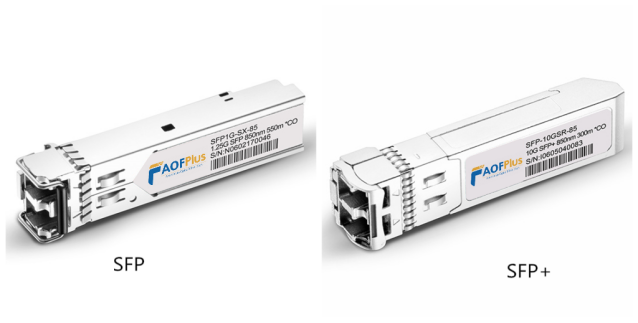
Small Form-Factor Pluggable (SFP) transceivers were first introduced in 2001. They are compact, hot-pluggable transceivers used to connect network devices such as switches, routers, and network interface cards. As a successor to the Gigabit Interface Converter (GBIC), it is also known as Mini-GBIC. SFP ports and SFP modules on switches allow for the transmission and reception of data over fiber optic and Ethernet cables. SFP optical transceivers are built based on the Multi-Source Agreement (MSA) standard, ensuring compatibility between network components from different manufacturers. Based on IEEE 802.3 and SFF-8472 standards, SFP modules are commonly used in Gigabit Ethernet and Fast Ethernet applications.
What is SFP+?
The Small Form-Factor Pluggable Plus (SFP+), first introduced on May 9, 2006, is an enhanced version of the SFP. Like its predecessor, the SFP+ is a hot-pluggable, compact module used for transmitting data between different network devices. With its improved optical and electrical components, the 10 Gbit/s SFP+ plays a crucial role in modern, demanding network environments. The Fibre Channel protocol allows SFP+ to operate at a maximum data rate of up to 16 Gbps. SFP+ modules can be used with direct attach cables (DACs) for short-distance connections or with active optical cables (AOCs) for longer transmission distances.
SFP VS SFP+: What Are the Differences?
Although both SFP and SFP+ are designed to connect network devices for high-speed data transmission, they differ in several aspects:
Data Rate
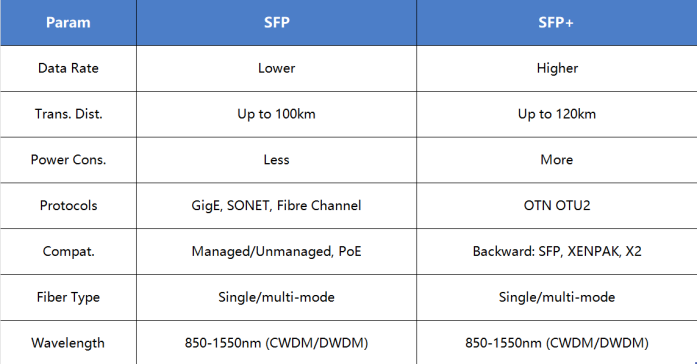
According to the SFF INF-8074i standard, common SFP modules have a nominal speed of 1 Gbps, typically used in Fast Ethernet (100 Mbps) and Gigabit Ethernet (1 Gbps) applications. Compared to SFP, SFP+ is designed for 10 Gigabit Ethernet and is commonly used in data centers and other demanding environments.
Transmission Distance
Depending on the fiber type, SFP and SFP+ have different transmission distances in various Fast Ethernet physical layers. The most common SFP transceivers use an 850nm wavelength and can support transmission distances up to 500 meters using multimode fiber. Single-mode SFP transceivers can achieve even longer distances. 10 Gbps SFP+ transceivers can transmit up to 300 meters using multimode fiber and up to 120 kilometers using single-mode fiber, making them more suitable for connecting remote areas.
Power Consumption
SFP+ transceivers generally consume more power because they require more power to handle higher speeds and greater bandwidth. However, in the long run, their enhanced capabilities allow them to deliver higher data rates with lower power consumption.
Supported Protocols
SFP: SFP supports protocols such as Gigabit Ethernet, SONET (Synchronous Optical Network), Fibre Channel, and other standards.
SFP+: In addition to Gigabit Ethernet and Fibre Channel communication standards, SFP+ also supports the OTN (Optical Transport Network) standard OTU2, which can transmit OC-192, STM-64, or Wide Area Network (WAN) physical layers (PHY) for 10G Ethernet.
Compatibility
SFP+ has higher compatibility because it is backward compatible with SFP, XENPAK, and X2. SFP modules are compatible with managed or unmanaged converters and PoE switches, while SFP+ is typically used with managed switches for optimal performance. In many cases, SFP and SFP+ can be used interchangeably because they have similar appearances.
SFP VS SFP+: How to Choose?
To make the right choice, you need to consider several factors.
First, you need to assess your network performance requirements. SFP supports data rates up to 1 Gbps, suitable for small home and office networks. In contrast, SFP+ can provide maximum speeds of up to 16 Gbps in Fibre Channel applications, making it ideal for switch stacking, large enterprise networks, and data centers. 10 Gbit/s SFP+ transceivers are particularly common in large enterprise and telecommunications networks, as well as other data-intensive applications.
You should also consider compatibility with your network equipment. SFP and SFP+ can work seamlessly with most modern switches, routers, PoE switches, and media converters. SFP+ generally offers broader compatibility than SFP transceivers. Additionally, you should consider your budget, as SFP+ may be more expensive.
The type of fiber optic cable is also a crucial factor affecting network performance. Generally, single-mode fiber optic cables are suitable for long-distance transmission, while multi-mode fiber optic cables are used for shorter distances.
Other Types of Transceivers
There are several other common types of pluggable transceivers on the market. Please read the following:
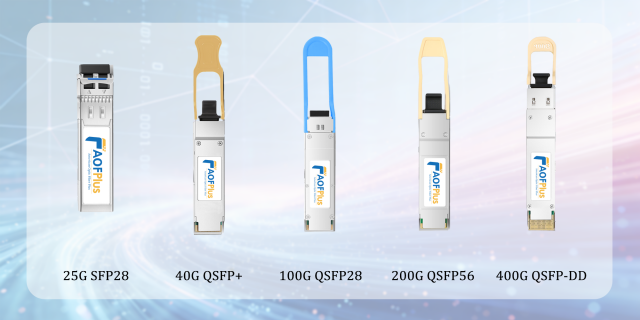
SFP28: SFP28 is an enhanced version of SFP+, but its appearance is similar to SFP or SFP+. Introduced on September 13, 2014, SFP28 conforms to the SFF SFF-8402 standard. It has a channel bandwidth of 28 Gbps, but primarily supports a data rate of 25 Gbps. SFP28 is widely used in 25G Ethernet and Common Public Radio Interface (CPRI).
QSFP+: Introduced on April 1, 2012, QSFP+ follows the SFF SFF-8436 standard. QSFP+ is built upon QSFP (Quad Small Form-factor Pluggable) but supports high-density 40G Ethernet. It provides four independent 10G channels for a single 40G Ethernet connection or four independent 10G connections (e.g., 10G Ethernet, 10G Fibre Channel, or Quad Data Rate (QDR) InfiniBand). It is widely used in data centers, high-performance computing (HPC), and storage.
QSFP28: QSFP28 was introduced on the same day as SFP28 and conforms to the SFF SFF-8665 standard. QSFP28 provides four 28 Gbps channels but is primarily used for aggregating 100 Gbps connections. The connection format can be 4x25G, 2x50G, or 1x100G.
Conclusion
The main difference between SFP and SFP+ pluggable transceivers lies in their data transmission rates. Therefore, SFP is suitable for small to medium-sized networks, while SFP+ is designed for more complex and high-density networks. Understanding these differences, you should evaluate your required network performance, cost, and compatibility with existing network equipment.