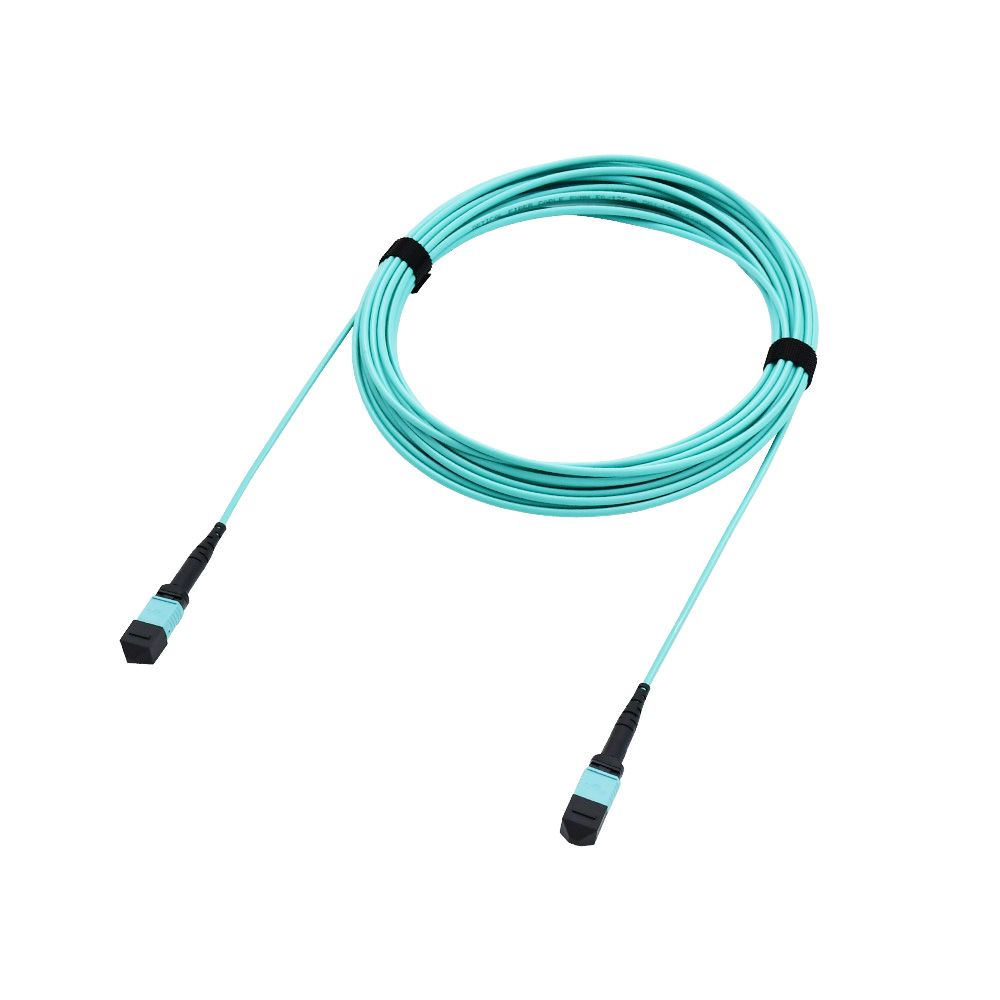
Due to the transmission of large-scale data, the demand for higher bandwidth and faster speeds is rapidly increasing. To meet this demand, the basic structure of network cabling needs to be upgraded. For example, copper cables have evolved from Category 1 to Category 8, and similarly, fiber optic cabling has also seen its innovations. In particular, there are OM1, OM2, OM3, and OM4 multimode fiber patch cables.
OM1 fiber optic patchcords have an inner diameter of 62.5um, and OM2 fiber patch cords have an inner diameter of 50um. OM3 and OM4 fiber optical patch cords are designed for higher bandwidth requirements and are primarily used to optimize and upgrade 40/100 Gigabit Ethernet. However, a question often puzzles us: Which is better: OM3 or OM4 fiber optical patch cord?
The Similarities between OM3 and OM4 Fiber Optic Patchcord
Firstly, the fiber types and structures are identical. Both OM3 and OM4 optical patch cords have an inner diameter of 50/125 um and are classified as laser-optimized multimode fibers (LOMMF), typically used with 850nm wavelength VCSEL laser sources. Their external structure and basic manufacturing processes are essentially the same.
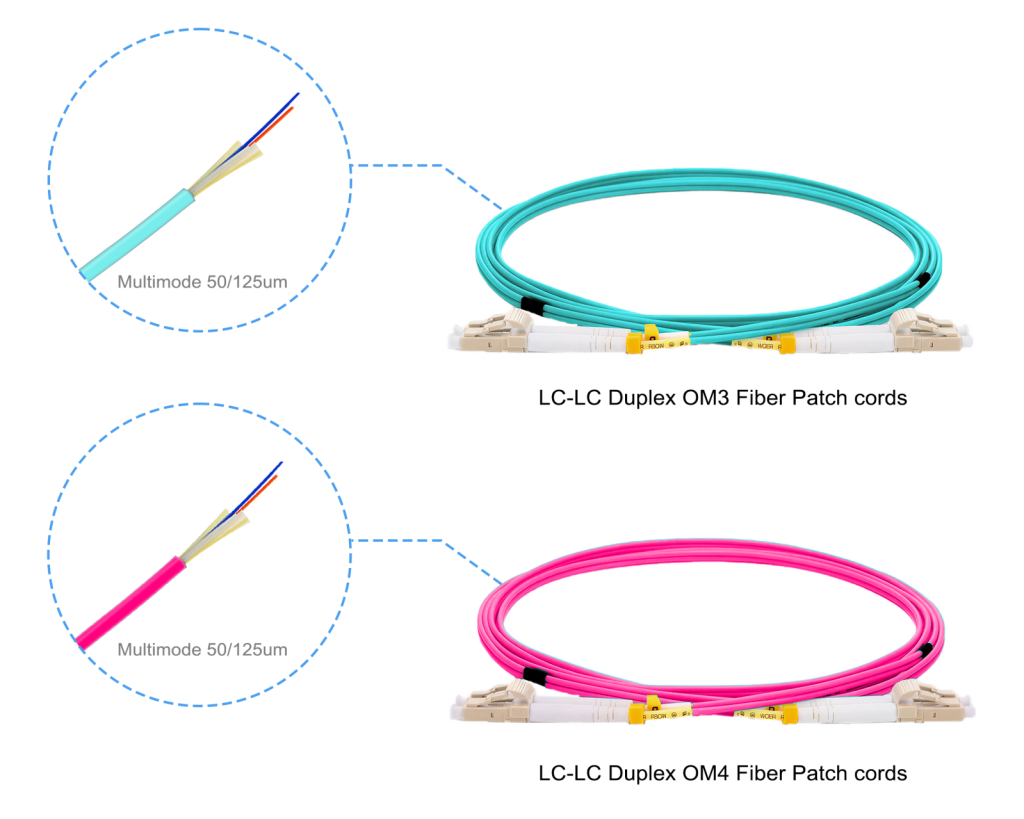
Secondly, both OM3 and OM4 fiber patchcords are widely used in data centers, enterprise server rooms, and high-speed local area network environments, supporting 10G, 40G, and 100G Ethernet. They are primarily used for short-distance high-speed interconnections between devices, such as within and between equipment racks. Furthermore, in terms of cabling, termination, testing, and daily maintenance, the construction specifications, connector types (such as LC, SC, MTP/MPO), and testing methods for OM3 and OM4 fiber optic patchcords are basically the same, resulting in similar ease of use and management.
The Difference between OM3 and OM4 Fiber Optic Patchcord
Due to its superior fiber optic cable structure, OM4 fiber patch cables (4700 MHz) operate at a higher bandwidth than OM3 (2500 MHz). The higher bandwidth of OM4 fiber optic patchcord means less modal dispersion, allowing for longer cable runs or greater loss tolerance when using matching connectors. This provides more options in network design. Furthermore, OM4 fiber patchcords have better attenuation, resulting in lower loss than OM3 optical patch cord. As we know, lower loss means we can have longer links or more matching connectors in the link.
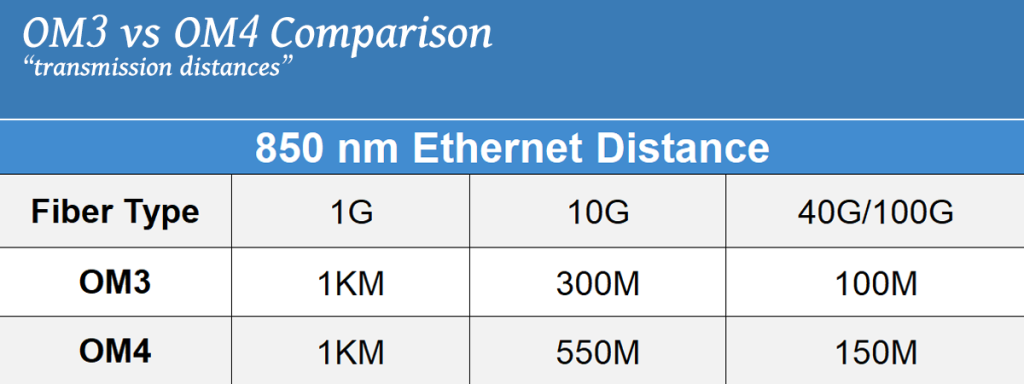
At the same data rate, OM4 fiber optical patch cord can achieve longer transmission distances. In practical applications, OM4 fiber patch cables offer a maximum transmission distance of up to 550 meters in 10G Ethernet environments, a significant improvement compared to OM3 fiber optical patch cord’s 300 meters. In 40G and 100G (SR4) applications, OM4 also supports a transmission distance of 150 meters, while OM3 optical patch cord typically supports only 100 meters. This distance advantage makes OM4 fiber optic patchcord more suitable for cross-rack and cross-area cabling requirements in large data centers.
In terms of applications, OM3 fiber patchcords are more widely used than OM4, primarily because they were introduced earlier and have a larger installed base, becoming a mature standard in multimode fiber cabling. At the same time, OM3 fiber optical patch cord strikes a good balance between cost and performance, meeting the needs of most data centers and enterprise networks for 10G and some 40G/100G applications. In practical use, OM3 optical modules and related products are more abundant, less expensive, and offer better compatibility and availability, making them widely adopted in existing networks and for routine upgrades.
However, OM4 fiber optic patchcords are better suited for high-density and high-speed applications and offer better future scalability, mainly due to their higher effective bandwidth and superior signal transmission performance. In high-end data centers and high-density cabling environments, OM4 optical patch cord can maintain lower signal loss and error rates at high transmission speeds such as 40G and 100G, accommodating the needs of parallel transmission across a large number of ports. At the same time, OM4 fiber patchcord provides more ample performance headroom for network planning, reducing the cost of rewiring and equipment replacement when upgrading to higher speeds in the future, making it an ideal choice for long-term construction and continuous expansion.
From a cost perspective, OM4 fiber optic patch cables are typically more expensive than OM3 fiber optic patchcords due to their higher bandwidth performance and stricter manufacturing standards.
Conclusion
Both OM3 and OM4 fiber optic patchcords play important roles in modern high-speed network infrastructure. OM3 fiber optic patchcord offers a cost-effective, mature solution suitable for most existing data center and enterprise network applications, while OM4 fiber patchcord provides higher bandwidth, longer transmission distances, and greater scalability for high-density, high-speed, and future-proof network deployments. Selecting between OM3 and OM4 optical patch cord ultimately depends on the specific performance requirements, network scale, and long-term planning goals, ensuring an optimal balance between cost, performance, and future expansion. As a leading fiber optic patchcord supplier in the industry, AOFPLUS offers a wide range of high-quality fiber patchcords to meet diverse networking needs. Our fiber optic patch cables come in various speeds, transmission distances, and connector types, enabling us to provide customized solutions for various industries.