QSFP-DD vs. QSFP28/QSFP56: Why are there so many different QSFP interfaces? The rapid development of cloud data center networks and interconnects is driving technological advancements to meet the ever-increasing demand for bandwidth connectivity. From the rise of 40G-QSFP transceivers to the successful application of the 100G-QSFP28 form factor, the next major development is 200G and 400G Ethernet technology and optical transceivers using the QSFP-DD form factor.
The currently widely used 100G QSFP28 transceiver form factor, and the subsequent 200G QSFP56 transceiver form factor, ultimately led to the emergence of a brand-new optical transceiver form factor—QSFP-DD. As a professional optical transceiver supplier, AOFPLUS provides high-quality QSFP series transceivers, including QSFP-DD, QSFP28 and QSFP56, to meet the bandwidth needs of cloud data centers for 100G, 200G and 400G Ethernet networks.
This article will help you quickly understand the main differences between QSFP-DD, QSFP56, and QSFP28.
QSFP-DD vs QSFP28 / QSFP56
QSFP-DD vs QSFP28 / QSFP56 Difference- Data Rate
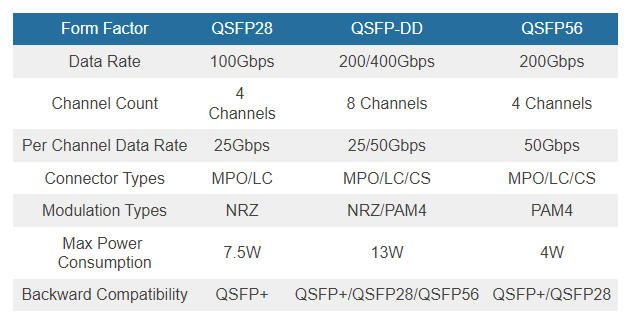
The first fundamental parameter describing an optical transceiver is the data rate. Data rate is defined as the amount of data transmitted over a network in a specific period of time. Different transceivers modules and corresponding network technologies have different data rate values.
The QSFP-DD has a maximum data rate of 200Gbps or 400Gbps, depending on the signal modulation technology used. The main difference between the QSFP-DD and the QSFP56 or QSFP28 is that the “DD” in its name stands for double density, meaning the number of electrical channels is increased from 4 to 8.
If NRZ modulation is used, the 8 channels operate at 25Gbps per channel, totaling 200Gbps.
If PAM4 modulation is used, the 8 channels operate at 50Gbps per channel, totaling 400Gbps.
(In comparison, the QSFP56 has a maximum data rate of 200Gbps, while the QSFP28 has a maximum data rate of 100Gbps.)
Comparison of transmission speeds based on network technologies:
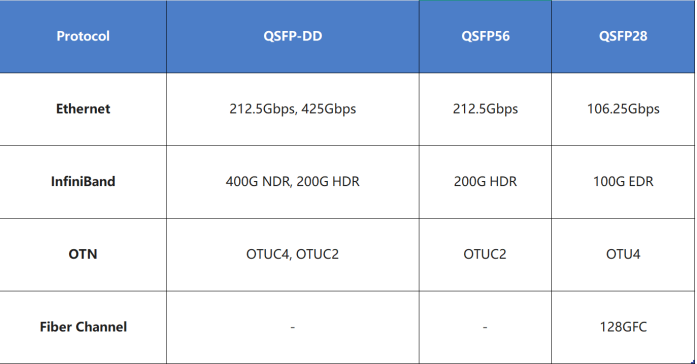
Ethernet technology has standardized the following data rates for the QSFP-DD standard: 212.5 Gbps and 425 Gbps.
InfiniBand is an industry-standard, channel-based switched interconnect architecture used for server and storage connectivity. InfiniBand has standardized the following data rates for QSFP28: 100G EDR; and for QSFP-DD: 200G HDR and 400G NDR.
Optical Transport Network (OTN) constitutes a universal Layer 1 transport network, enabling different service types to coexist and transparently share the same infrastructure without affecting each other’s performance. OTN specifies OTU4 for QSFP28 100G applications, OTUc2 for 200G applications, and OTUc4 for 400G applications (corresponding to QSFP-DD).
Fibre Channel: 128GFC (24850 56.1 PAM-4) was released in 2021, and a next-generation product with a higher data rate, 256GFC, was released in 2024.
QSFP-DD vs QSFP28 / QSFP56 Difference- Modulation Type
The next significant differentiating factor is the modulation method of the transceiver modules. Optical transceivers consist of a laser that emits light and a modulator. An optical modulator is a device used to control the characteristics of light, and it determines the transmission quality between transmitting devices.
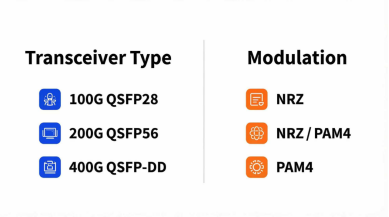
For pluggable optical transceivers, the intensity of the light is modulated. Engineers have long used Non-Return-to-Zero (NRZ) modulation technology for 1G, 10G, and 25G transmission, and utilized Forward Error Correction (FEC) technology on the host side for longer-distance transmission. For higher data rates of 40G and 100G, the industry introduced parallelization techniques of 10G and 25G NRZ modulated signals. In short, lower-speed optical transceiver modules (1G, 10G, 25G, and most 100G optical modules) use NRZ two-level modulation of light intensity, and are therefore binary.
NRZ modulation technology is less efficient for 200G, 400G, and other higher data rate transmissions than for lower-speed transmissions. Therefore, network scientists developed PAM4 modulation technology for these high-bandwidth data rates.
Different Modulation Techniques:
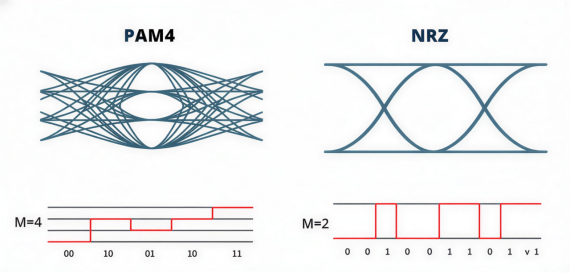
NRZ (Non-Return-to-Zero) is a two-level binary encoding that uses low and high voltage signals to represent the 1/0 information of digital logic signals. NRZ can only transmit 1 bit of information per signal symbol period, i.e., 0 or 1.
PAM4 (Pulse Amplitude Modulation 4) is a four-level signal modulation format used for signal transmission. Each signal level can represent 2 bits of logical information.
This means that using PAM4 modulation, the time required for information transmission can be halved, or twice the amount of information can be transmitted in the same amount of time.
In practice, this can be verified with a 400G transceiver. This transceiver has a built-in DSP gearbox that converts eight 25GBaud PAM4 signals into four 50GBaud PAM4 signals. Therefore, through PAM4 modulation, four 50GBaud signals can be extended to four 100Gbps lanes, which are then multiplexed to achieve a 400Gbps data rate.
Summary:
QSFP-DD vs QSFP28 / QSFP56 Difference- Power Consumption
The power consumption of optical transceivers is closely related to the overall power budget of the host device. The higher the power consumption of the optical transceiver, the fewer transceivers modules can be used in the host device. Therefore, lower overall power consumption of both the optical transceiver and the host device leads to better performance and a smaller environmental impact.
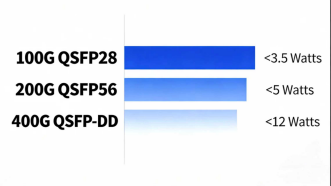
The maximum power consumption of a QSFP-DD optical transceiver is 12 watts.
The maximum power consumption of a QSFP56 optical transceiver is less than 5 watts.
The maximum power consumption of a QSFP28 optical transceiver is less than 3.5 watts.
Generally, lower power consumption results in lower module temperature, higher reliability of the optical transceiver, and better overall performance.
Summary:
QSFP-DD vs QSFP28 / QSFP56 Difference – Connector Types
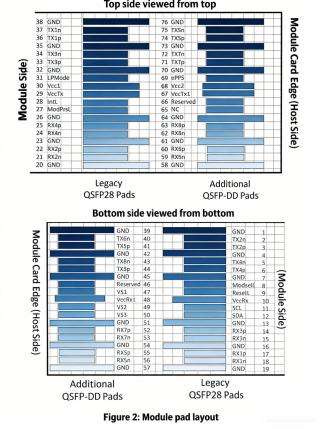
Optical transceivers have two ports. One end is an electrical connector used to connect to the host device (switch, router, etc.), and the other end is a laser output port used to connect to the optical fiber. QSFP28 and QSFP56 transceivers have a 38-pin electrical interface for connecting to the host device. However, due to its double-density design, the QSFP-DD has twice the number of electrical pins, reaching 76. This means that systems (host devices) equipped with QSFP-DD ports are backward compatible with QSFP56 and QSFP28 transceivers. In practice, this means that if you have a router equipped with QSFP-DD ports, you can easily insert QSFP56 or QSFP28 transceivers into these ports (please check the product datasheet before connecting to confirm whether the port logically supports QSFP56 or QSFP28 transceivers).
The image below shows the solder pads for the QSFP28 and the additional solder pads for the QSFP-DD to accommodate the dual-channel interface.
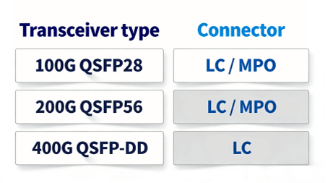
Both ends of the optical transceiver are equipped with compatible fiber optic connectors, utilizing a female socket connection mechanism. These connectors can be of the following types: LC and MPO.
QSFP-DD vs QSFP28 / QSFP56 Difference- Dimensions
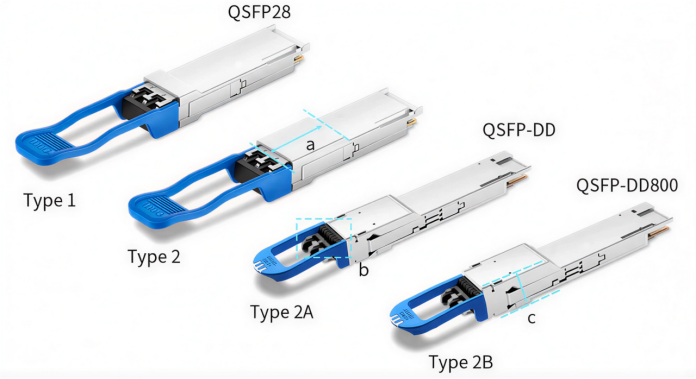
QSFP-DD is the latest and highest data rate transceiver, with slightly different dimensions compared to QSFP56 and QSFP28 transceivers. Due to the addition of four extra wires, the QSFP-DD is slightly longer, making it a double-density transceiver (its electrical interface contains more pins – 76).
QSFP-DD: 18.35 / 89.4 / 8.5 mm
QSFP56: 18.35 / 72.3 / 8.5 mm
QSFP28: 18.35 / 72.3 / 8.5 mm
More on QSFP-DD Form Factor and Module Types
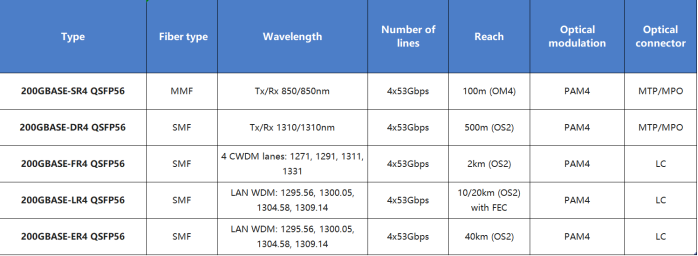
More on QSFP56 Form Factor and Module Types
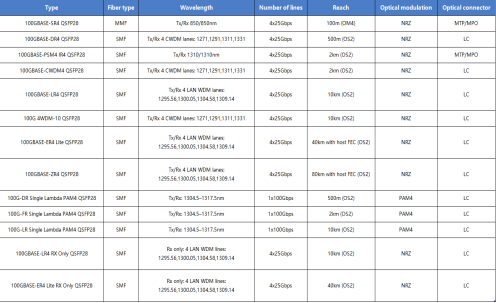
More on QSFP28 Form Factor and Module Types
Conclusion
QSFP-DD, QSFP56, and QSFP28 transceivers differ in many aspects. For the latest QSFP-DD transceivers, the most significant difference is that this double-density package integrates a dual 4-channel electrical interface, comprising a total of 8 electrical channels. This allows it to support data rates up to 400Gbps. The 8-channel technology used in QSFP-DD increases its length to 89.4 mm (compared to 72.3 mm for QSFP56 and QSFP28). Furthermore, the number of electrical contact connector pins in QSFP-DD is also doubled (76 pins) to accommodate the 8-channel interface.
QSFP-DD achieves 400Gbps data rates through PAM4 modulation technology. This modulation technique is new to optical transceivers, as previous 100G-QSFP28 transceivers used two-level NRZ modulation. PAM4 modulation is a four-level amplitude modulation, where each level can represent 2 bits of information. Therefore, using PAM4 modulation, the information transmission time can be halved—or twice the amount of information can be transmitted in the same amount of time. Based on this principle, QSFP-DD can achieve unprecedented higher data rates.
Due to the integration of new technologies, QSFP-DD also reaches unprecedented power consumption levels. The peak power consumption of QSFP-DD can be as high as 12 watts. This is a significant increase compared to the 3.5 watts of QSFP28. This increased power consumption enables it to achieve the promised 400Gbps data rate.
Both QSFP-DD and QSFP56 will be equipped with the latest CS connectors in the near future. The CS connector uses a dual LC-type push-pull coupling mechanism and is significantly smaller than traditional duplex LC connectors. The smaller size doubles the connector density on the switch front panel. It also allows for connections between two 400Gbps QSFP-DD transceivers or splitting the signal to two 200Gbps QSFP56 transceivers.
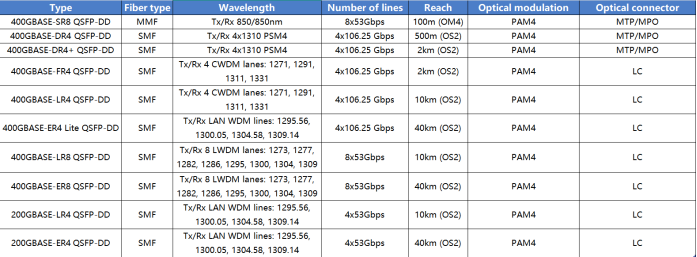
The QSFP-DD form factor is used for 400Gbps and some 200Gbps transceivers. The main differences between the various 400G QSFP-DD transceiver types lie in their operating distance and the wavelengths used. For example, the 400GBASE-SR8 is the only QSFP-DD transceiver version that uses multimode fiber, with a transmission distance of up to 100 meters. The highest-end 400GBASE-ER8 version, on the other hand, uses single-mode fiber and has a transmission distance of up to 40 kilometers. Many other versions exist between these two extremes.