Have you ever seen a fiber optic cable with connector on only one end? This type of cable is called fiber optic pigtail. Fiber optic pigtails and fiber patch cords are two different types of fiber optic products. What are the differences between fiber optic pigtails and fiber optic patch cords? What are the common applications of fiber optic pigtails? This article will delve into all aspects of fiber optic pigtails.
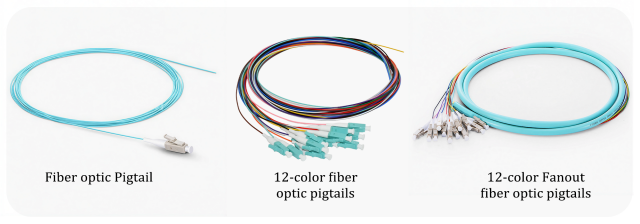
What is a Fiber Optic Pigtail?
Fiber optic pigtail is a cable that only one end is terminated with connectors, which is used to connect to optical devices. The other end can be melted with optical fiber for a permanent connection. This design provides convenience for fiber optic networks, especially in field termination pplications, thereby improving network performance and reliability. AOFPLUS is an experienced fiber optic supplier, providing professional fiber optic products and one-stop services, like fiber optic pigtail. AOFPLUS can meet all your needs, if you have any questions or want to know more, please feel free to contact us sales@aofplus.com.
Fiber Pigtail Types
There are many types of pigtails fiber optic, which we will explore in detail in the following sections.
By Fiber Type
Singlemode and multimode fiber pigtails are two common types classified according to the fiber type. Singlemode fiber pigtails typically use OS2 9/125um fiber and are terminated with singlemode connectors at both ends. Single-mode pigtail fiber can transmit data over distances up to 4 kilometers.
Multi-mode fiber optic pigtails are typically made with 62.5/125um or 50/125um fiber and terminated with multi-mode connectors.
In addition to OM1 and OM2, OM3/OM4/OM5 multi-mode fiber optic pigtails are also available for higher bandwidth applications.
By Fiber Optic Connector Type
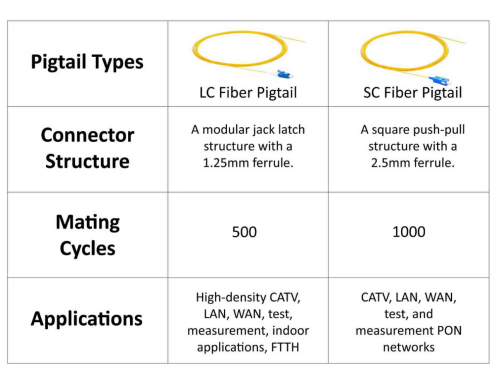
Currently, AOFPLUS focuses on providing high-quality fiber optic pigtails, covering two main types: SC and LC. The LC pigtail is renowned for its small, compact design, which effectively saves space in fiber optic distribution frames and equipment cabinets—making it widely used in high-density cabling environments such as data centers and enterprise networks. In contrast, the SC pigtail adopts a simple and reliable push-pull locking mechanism, ensuring stable connection, excellent signal transmission, and easy operation, so it is commonly applied in telecom networks, access networks, and other fields prioritizing convenient installation, maintenance, and stability.
LC pigtail: LC is short for Lucent Connector, a fiber optic connector with a square plastic housing and a 1.25 mm ferrule—approximately half the size of a standard fiber optic connector. Featuring low insertion loss and low return loss, its compact size and excellent performance make it ideal for high-density cabling environments.
SC pigtail: SC stands for Square Connector (also known as Subscriber Connector, a common professional alias). Though similar in appearance to the LC pigtail, it uses a 2.5 mm stainless steel ferrule. Its key advantages are low cost and high performance, making it a practical choice for fiber optic scenarios requiring cost-effectiveness and stability.
Both SC and LC pigtails from AOFPLUS comply with industry standards, ensuring consistent compatibility with mainstream fiber optic equipment and systems, further enhancing their applicability in various professional scenarios.
The table below lists the characteristics of two main types of fiber optic pigtails.
By Application Environment
Depending on the application environment, some fiber optic pigtails are designed for everyday general use, while others (such as armored and waterproof fiber optic pigtails) are designed to withstand harsh environments, including moisture, high temperatures, and heavy rain.
Indoor fiber optic pigtails: As the name suggests, indoor pigtails fiber optic are only suitable for indoor wiring. They do not have an extra protective layer, but are sufficient for indoor use. Due to their low cost and good flexibility, these pigtails are the most commonly used type.
Armored fiber optic pigtails: Armored pigtails fiber optic have an additional metal protective layer, making them more durable and effectively resistant to common external damage. They are suitable for harsh environments and provide extra protection.
Waterproof fiber optic pigtails: Waterproof fiber optic pigtails utilize stainless steel waterproof armored PE sheathing, featuring low insertion loss and high return loss, effectively resisting harsh environments. These pigtails are typically equipped with waterproof connectors to ensure optimal performance. Their excellent resistance to harsh environments makes them an ideal choice for connecting trunk fiber optic cables and optical receivers. Furthermore, their waterproof and corrosion-resistant properties make them widely used in outdoor fiber optic network construction, such as in cable television (CATV) installations and military applications.
By Fiber Count
Fiber optic pigtails are available in various specifications, including 1, 2, 4, 6, 8, 12, 24, 48, and 72 cores. The optical fibers are color-coded according to the TIA-EIA-598-A standard. Typically, single-core fiber optic pigtails are the most common type used in everyday life.
By Polish Type
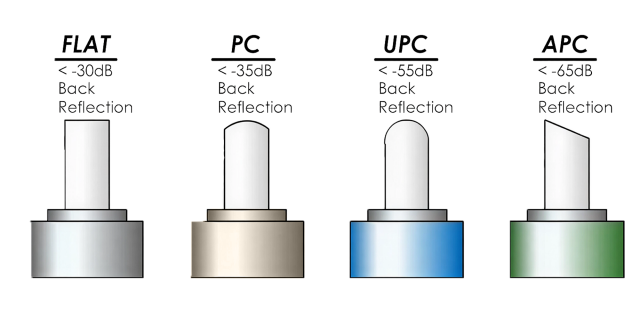
Based on the polishing type, fiber optic pigtails can be classified into PC, UPC, and APC types. PC, UPC, and APC types are all suitable for both single-mode and multi-mode fibers. The different polished end faces of the connectors affect the return loss of the fiber optic connector.
PC Fiber Optic Pigtails: PC fiber optic pigtails use physical contact connectors. Most multimode fiber optic pigtails use PC connectors, but they are gradually being replaced by UPC pigtails.
UPC Fiber Optic Pigtails: UPC stands for Ultra Physical Contact connector, which has a slightly domed end face. It is considered the most common type for both single-mode and multimode fiber patch cords.
APC Fiber Optic Pigtails: APC stands for “Angled Physical Contact”. APC fiber optic pigtails have an interface polished at an 8-degree angle to reduce back reflection and are commonly used in CATV, FTTx, and other fields.
Fiber Pigtail VS. Fiber Patch Cord
Fiber optic pigtails and patch cords play different roles in fiber optic networks. They differ in structure, design purpose, and application scenarios.
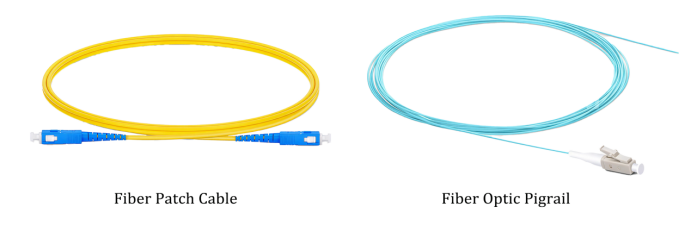
A fiber optic pigtail is typically a short length of fiber optic cable with a connector pre-installed on one end. A fiber optic patch cord (also known as a fiber optic jumper) has connectors on both ends. One fiber optic patch cord can be divided into two fiber optic pigtails.
Fiber optic patch cords are crucial for connecting various network devices, such as switches, servers, and fiber optic distribution frames. They utilize a variety of different jacket materials, including ONFR, ONFP, and LSZH, to meet different environmental requirements. Fiber patch cords offer a wide range of configurations and lengths, providing flexibility for temporary or permanent network connections.
In contrast, fiber optic pigtails are primarily used for fiber splicing to create permanent connections. They are also used to connect fiber optic cables to common termination points found in fiber optic devices and components.
Advantages and Disadvantages of Fiber Optic Pigtails
Advantages:
Easy Installation: Fiber optic pigtails are easy to install and can be quickly connected to other devices.
Wide Range of Applications: Available in various connector types and lengths, suitable for a wide range of applications.
Cost-Effective: Fiber optic pigtails are less expensive than full-length fiber optic cables.
Simplified Cabling: A single fiber optic pigtail can accommodate multiple fibers, reducing cable clutter.
Improved Performance: Factory pre-terminated pigtails ensure high-speed and reliable signal transmission.
Disadvantages:
Vulnerability: The bare fiber on fiber optic pigtails is susceptible to damage during installation and maintenance.
Length limitations: Fiber optic pigtails are typically short in length and may not be suitable for applications requiring longer cables.
The Applications of Fiber Optic Pigtail
Fiber optic pigtails can be used in a variety of applications.
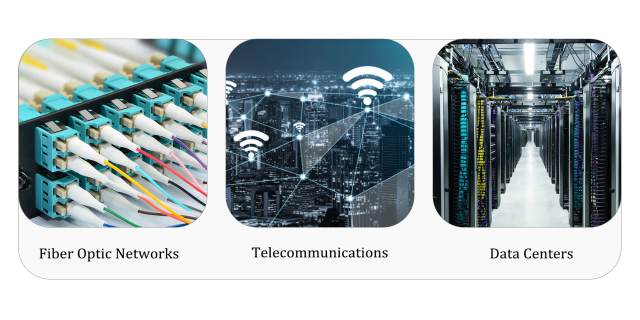
Fiber Optic Networks
Fiber optic pigtails are a key component in fiber optic networks. Their simple cabling method makes them easier to install than direct connection cables. They are typically used in conjunction with optical devices such as optical transceivers and optical splitters. In addition, fiber pigtails can be used for daily testing and maintenance of fiber optic networks by connecting equipment to the network.
Telecommunications
With their flexibility and stability, fiber optic pigtails are also used in the telecommunications field to build reliable and stable communication networks.
Data Centers
With their high bandwidth, low latency, and high security, fiber optic pigtails can handle massive amounts of data in data centers.
With the ever-increasing demand for high-bandwidth and high-speed applications, fiber optic cables have been widely used in many scenarios. This demand has also driven the application of fiber optic pigtails in a wider range of fields, including the Internet of Things (IoT), smart cities, environmental sensing, health monitoring, and industrial automation.
Fiber Optic Pigtail Splicing
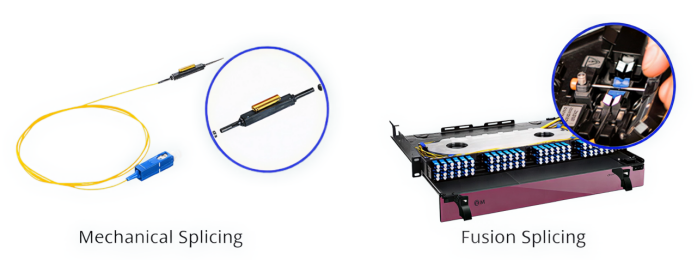
Fiber Optic Pigtail Splicing: Splicing fiber optic pigtails is a common method for connecting two fiber optic cables. Mechanical splicing and fusion splicing are the two most commonly used splicing methods. Mechanical splicing uses a mechanical splicer and refractive index matching gel to connect the ends of two optical fibers, providing a quick and easy splice. Fusion splicing, on the other hand, uses a dedicated splicing machine to heat and melt the two pigtails, creating a permanent connection. Compared to mechanical splicing, fusion splicing has lower loss and less return loss, making it a better method for fiber optic connection, but it is also more expensive. Incorrect splicing can affect the transmission of optical signals between the two fibers. If you are new to fiber optic splicing, it is best to seek professional assistance.
Fiber optic pigtails play a crucial role in fiber optic networks. They are an effective solution for connecting bare fibers or fiber optic patch panels, saving both cost and labor.