With the rapid development of mobile internet, cloud computing, big data, and other technologies, the entire communications industry, after the 10G-40G-100G or 10G-25G-100G stages, is demanding higher speeds, greater bandwidth, and lower latency from networks, urgently requiring an upgrade to higher levels. The application of 200G and 400G Ethernet in data centers is receiving increasing attention, and the choice between 200G and 400G Ethernet has become a hot topic in the industry.
Brief Introduction of 200G and 400G Optical Transceivers
200G optical transceivers are high-performance transceiver modules designed to support data transmission rates of 200 gigabits per second (Gbps) over fiber optic cables. These transceivers use advanced modulation techniques such as PAM-4 (Pulse Amplitude Modulation) to efficiently double the data rate compared to traditional NRZ (Non-Return to Zero) technology. A key feature of 200G optical transceivers is their multi-lane architecture, where the total bandwidth is achieved by utilizing multiple channels, each typically operating at 100G or lower. A 400G fiber transceiver refers to an optical transceiver product with a transmission rate of 400 Gbps. It represents the next generation of high-speed optical transceiver, offering significantly greater bandwidth compared to previous-generation transceivers like 100G and 200G. These transceivers are typically built around QSFP-DD (Quad Small Form-factor Pluggable Double Density),which allows for more compact designs while maintaining high port density.
These fiber optic transceivers utilize advanced modulation techniques like PAM-4 (Pulse Amplitude Modulation), which enables higher data rates by transmitting more bits per symbol. For example, 400G fiber transceivers often feature multiple lanes (typically four 100G channels or two 200G channels), allowing them to achieve their high-speed capabilities while ensuring efficient data transfer over optical fibers.
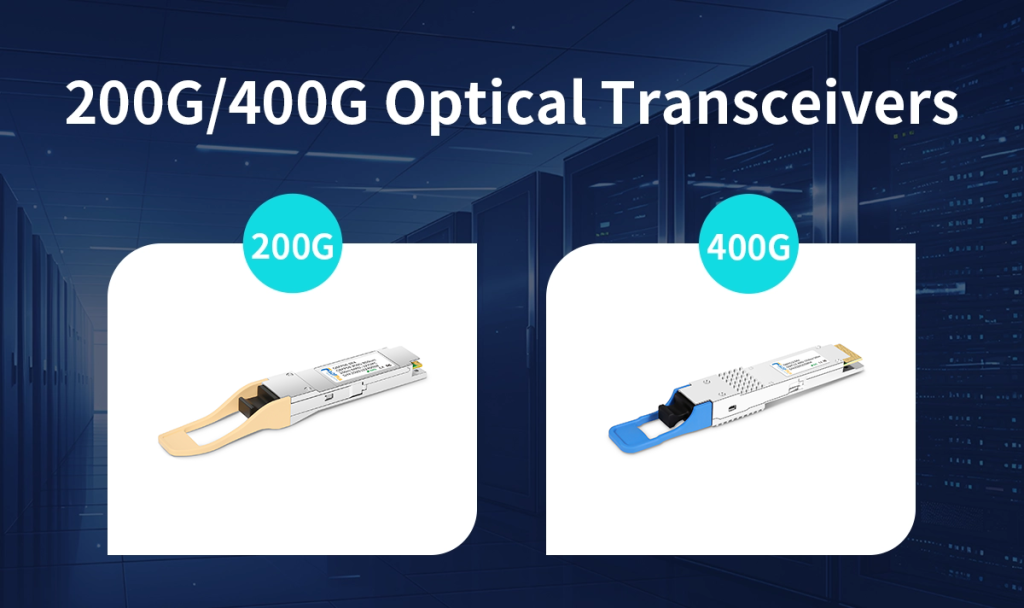
The Difference between 200G and 400G Optical Transceivers
Transmission rate: The maximum transmission rate of a 200G transceiver module is 200 Gbps (200 gigabits per second). The maximum transmission rate of a 400G fiber transceivers is 400 Gbps, meaning its bandwidth is twice that of a 200G optical module. This makes it suitable for environments requiring greater bandwidth, such as hyperscale data centers and long-term operational network backbones.
Form Factor:200G fiber optic transceivers typically use QSFP56 (Quad Small Form-factor Pluggable) or OSFP (Octal Small Form-factor Pluggable) as the transceiver packaging standard. QSFP56 is currently the more common packaging standard for 200G optical transceivers, offering a smaller size and higher port density.
Currently, QSFP-DD (Double Density) is the most common packaging standard for 400G fiber transceivers. This packaging method allows for more ports in a smaller volume (typically supporting 400G with four 100G channels or two 200G channels).
Power Consumption:Due to their lower bandwidth, 200G transceiver modules typically have lower power consumption, making them suitable for medium-sized data centers and enterprise-level deployments.
In contrast, 400G transceivers have higher power consumption because they need to support higher data transmission rates. To maintain stable operation, better heat dissipation design and power management are required. 400G transceivers usually require more efficient cooling systems, especially in high-density deployment environments.
Cost: 200G optical transceivers are less expensive because they have lower bandwidth and utilize more mature technology, making them suitable for medium-sized networks and short-term expansion needs.
400G fiber optic transceivers, on the other hand, are more expensive due to their higher bandwidth, greater technical complexity, and higher power consumption.
Development Trends of 200G/400G Optical Transceivers
A foreseeable trend in the data center optical interconnect market is the gradual phasing out of low-speed optical modules in core networks and data centers, with the main transition being from 10G to 40G and then from 40G to 100G. New developments in 100G optical devices have paved the way for 200G/400G optical devices.
Compared to the previous generation of 100G optical transceivers, 200G fiber transceivers offer a five-fold increase in transmission speed while significantly reducing costs. Therefore, 200G transceiver modules have become one of the mainstream transceivers on the market, widely used in data centers, internet data centers, and enterprise data centers.
400G fiber optic transceivers, on the other hand, provide even higher transmission speeds and greater bandwidth, meeting the needs of higher-performance computing, storage, and network equipment. They are therefore widely used in cloud computing, big data, and artificial intelligence. In the future, 400G optical transceiver technology will continue to develop and mature.
Conclusion
As the demands for higher bandwidth, faster speeds, and lower latency continue to grow across various industries, the adoption of 200G and 400G optical transceiver has become a crucial step towards meeting these needs. While 200G transceivers offer an effective solution for medium-sized networks and enterprise-level applications, 400G fiber optic tranceivers are poised to power the next wave of ultra-high-performance networks, supporting cloud computing, big data, and AI-driven technologies. As data centers and communication networks evolve, transitioning to these higher-speed optical modules will play a pivotal role in enabling more efficient, scalable, and future-proof infrastructures. With continued advancements in technology, we can expect both 200G and 400G solutions to become increasingly refined, offering even greater efficiency, cost-effectiveness, and performance in the years to come. As a leading industry supplier, AOFPLIS provides a wide range of high-quality fiber optic transceivers to meet diverse networking needs. Whether for data centers, enterprise networks, or 5G communication, AOFPLIS can offer advanced fiber optic solutions.