LC and SC patch cords differ significantly in their interface design, connection methods, application scenarios, and performance characteristics, as detailed below:
Interface Design
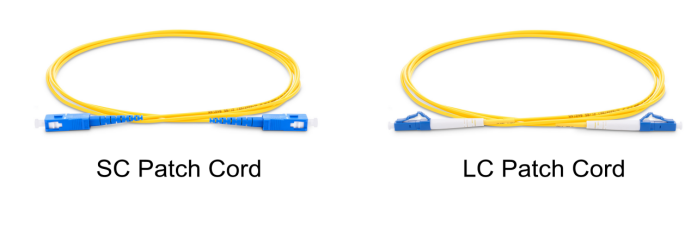
Appearance: Blue, large connector, rectangular housing, 2.5mm diameter ferrule.
Structure: Made of engineering plastic housing, resistant to high temperatures and oxidation, but the connector may loosen with prolonged use.
Design Features: Direct plug-and-play design, easy to operate, no rotation required.
LC Fiber Patch Cord
Appearance: Blue, small square connector, similar in appearance to a miniaturized SC connector, with a pin and ferrule diameter of 1.25mm (only half the size of an SC connector).
Structure: Features a metal casing and metal contacts, providing excellent resistance to impact, vibration, and tension.
Design Features: Utilizes a modular jack (RJ) latching mechanism, ensuring stable connection and suitability for frequent plugging and unplugging.
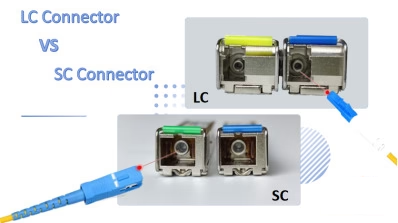
Connection Method
Connection Mechanism: Connects to an SC coupler via direct insertion and removal, without requiring rotation.
Advantages: Simple operation, suitable for rapid deployment.
Limitations: Long-term use may lead to connector loosening due to vibration.
LC Fiber Patch Cable
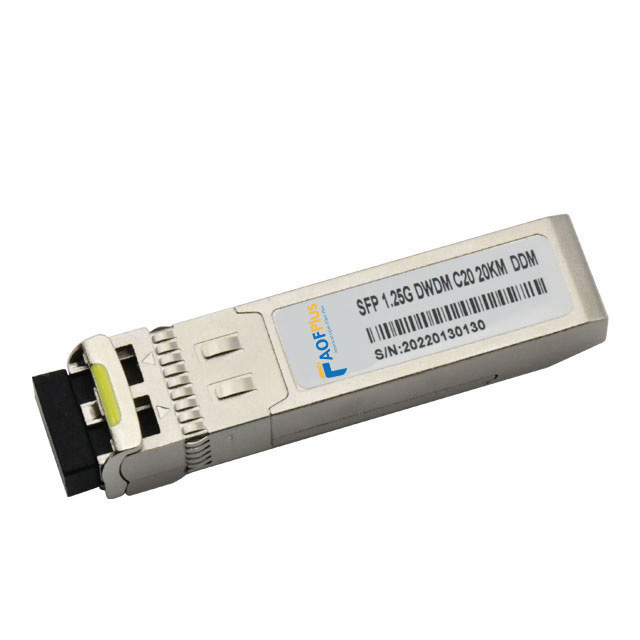
Connection Mechanism: Connects to SFP fiber optic modules via a latching mechanism; automatically locks into place upon insertion.
Advantages: Secure connection, suitable for high-density cabling environments.
Limitations: Requires compatibility with devices that support LC interfaces.
Application Scenarios
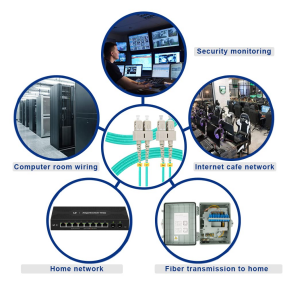
Typical applications:
Connecting optical interfaces of devices such as routers and switches.
General-purpose equipment such as fiber optic transceivers and optical modules.
Environments requiring high stability (e.g., telecommunications carrier networks).
Advantages: Strong versatility, high compatibility, suitable for medium-density cabling.
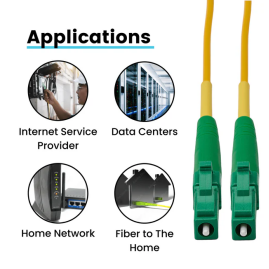
LC Fiber Optic Patch Cord
Typical Scenarios:
Dense connections between servers and switches in data centers.
High-density cabling environments (such as server rooms and enterprise networks).
Scenarios requiring modular design (such as SFP optical module connections).
Advantages: Small size, high density, space-saving, suitable for frequent plugging and unplugging.
Performance Characteristics
Insertion Loss: ≤0.5dB, ensuring high-quality data transmission.
Return Loss: ≥50dB (single-mode), ≥30dB (multimode), reducing reflection interference.
Stability: Long-term use may lead to signal attenuation due to loose connectors.
Insertion Loss: ≤0.3dB (superior to SC), more stable signal transmission.
Return Loss: ≥60dB (single-mode), ≥35dB (multimode), lower reflection interference.
Anti-interference: Metal casing design provides stronger electromagnetic interference resistance.
Space Efficiency: 50% smaller than SC, allowing for more ports per unit area.
Comparison and Summary
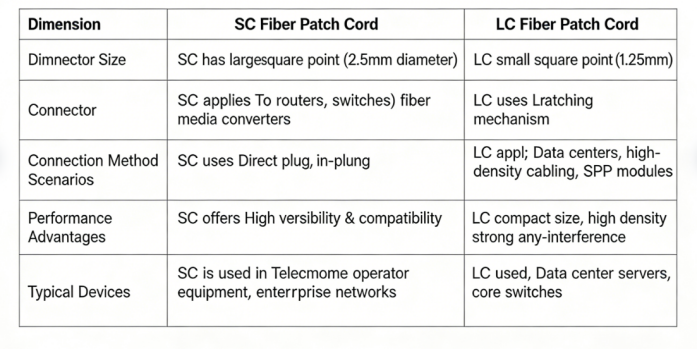
Selection Recommendations
Choose SC patch cords:
Suitable for compatibility with various devices (such as fiber optic transceivers and switches).
Ample wiring space available, and cost-sensitive.
Applications prioritize stability, with infrequent plugging and unplugging.
Choose LC patch cords:
Suitable for high-density wiring (such as data centers and server rooms).
Equipment supports SFP modules or modular design.
High requirements for signal quality and anti-interference, and frequent plugging and unplugging are needed.