MPO|MTP fiber patch cords are high-density multi-fiber connectors that achieve efficient and reliable optical signal connections through multi-core parallel transmission. They are widely used in scenarios requiring high-density fiber optic cabling. The following is a detailed description of their core application areas and technical characteristics:
Top3 Application of MPO|MTP Fiber Patch Cord
Data Centers
Equipment Interconnection: Connecting servers, switches, storage devices, etc., supporting high-speed network transmission such as 40G/100G/400G/800G. For example, 400G optical modules correspond to 12-core MPO|MTP, 800G uses 16-core or dual-row 12-core, and 1.6T uses dual-row 16-core/24-core.
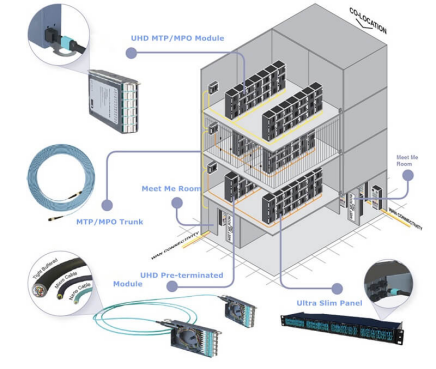
High-Density Cabling: Reducing the number of cables through multi-core parallel transmission, saving rack space and improving heat dissipation efficiency. For example, a 24-core MPO|MTP cable patch cord can replace 24 single-core fiber patch cables, increasing cabling density by more than 80%.
Enterprise Networks
Inter-building Local Area Network: Connecting switches in different buildings to achieve high-speed data transmission, supporting enterprise cloud office, video conferencing, and other applications.
High-Density Switching: Deploying MPO|MTP patch cords between core switches and access switches to meet the demand for 10 Gigabit/100 Gigabit port density.
Telecommunications
The telecommunications industry is another major user of MPO|MTP patch cords. With the increasing demand for high-speed internet access, mobile broadband, and video streaming, telecommunications service providers are constantly looking for ways to improve the performance and capacity of their networks. MPO|MTP patch cords are an essential component in modern telecommunications networks, providing high-density and high-speed connectivity solutions for a variety of applications.
Special Application of MPO|MTP Fiber Patch Cord
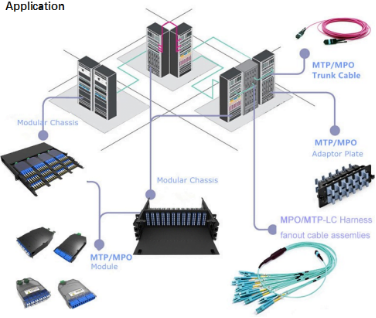
Wiring Box Management: Enables centralized connection and distribution of multi-core optical fibers within fiber optic distribution boxes, simplifying maintenance procedures.
Optical Active Device Interconnection: Connects optical modules such as lasers and detectors, enabling the transmission and conversion of optical signals.
Technical Features and Advantages of MPO|MTP Fiber Patch Cord
High-Density Design
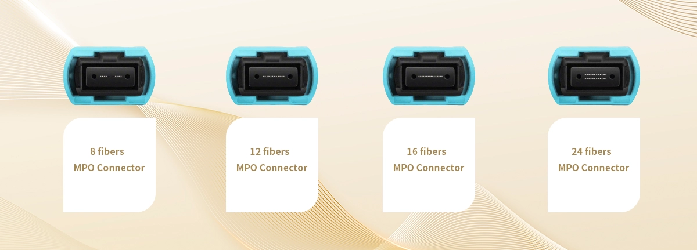
Multi-core Parallel Transmission: A single fiber optic patch cord supports 2-32 core fiber optic transmission, with 12-core, 16-core, and 24-core being the mainstream in the market.
Compact Size: The MPO|MTP connector has a diameter of only about 6mm, which is 1/3 the size of a traditional SC connector, saving more than 70% of space.
High-Speed Transmission
Rate Matching: The number of cores is selected according to the optical module rate, such as 12 cores for 40G and 24 cores for 100G, ensuring signal integrity and transmission efficiency.
Low Loss: Using precision ferrules and guide pins, the insertion loss is ≤0.35dB and the return loss is ≥55dB, meeting the requirements of high-speed networks.
Flexible Deployment
Polarity Management: Supports three polarity types: Type A (straight-through), Type B (crossover), and Type C (paired crossover), adapting to different link requirements.
Customization Options: Parameters such as core count, length, and connector type (e.g., FC, LC, SC, ST) can be customized according to requirements.
High Reliability
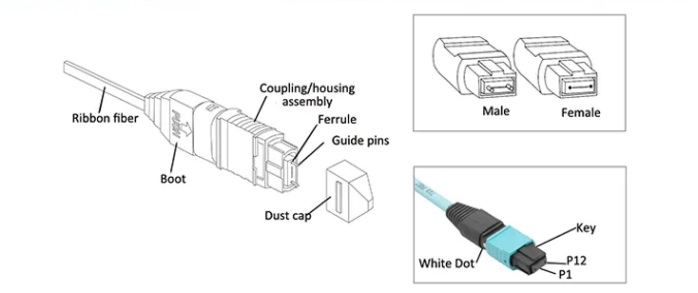
Dust Protection: The connector is equipped with a dust cap to prevent end-face contamination and extend its service life.
Tensile Strength Design: The cable bending radius is ≥20 times the outer diameter, and the bundling tightness is appropriate, preventing cable breakage or signal attenuation.
Typical Application Cases of MPO|MTP Fiber Patch Cord
Data Center Upgrad
A large data center uses 24-core MPO|MTP cable patch cords to connect servers and switches, increasing wiring density by 50% and reducing power consumption by 20%, supporting a smooth evolution to 800G/1.6T networks in the future.
FTTH (Fiber-to-the-Home)
Providing high-speed internet to residential areas, MPO|MTP fiber patch cords ensure reliable delivery of fiber-optic services. The global Fiber-to-the-Home/Building (FTTH/B) market is valued at approximately $25.1 billion in 2023 and is expected to grow significantly, reaching $54.7 billion by 2030. This represents a robust compound annual growth rate (CAGR) of 11.8% between 2023 and 2030, driving the need for efficient connectivity.
Enterprise Campus Network
A manufacturing park uses MPO|MTP fiber patch cables to build a local area network between buildings, supporting 10Gbps bandwidth coverage throughout the entire park and meeting the data transmission needs of industrial Internet of Things devices.
Deployment Considerations
Polarity Matching: Select the appropriate polarity type based on link requirements to ensure correct interconnection between the transmitter (Tx) and receiver (Rx).
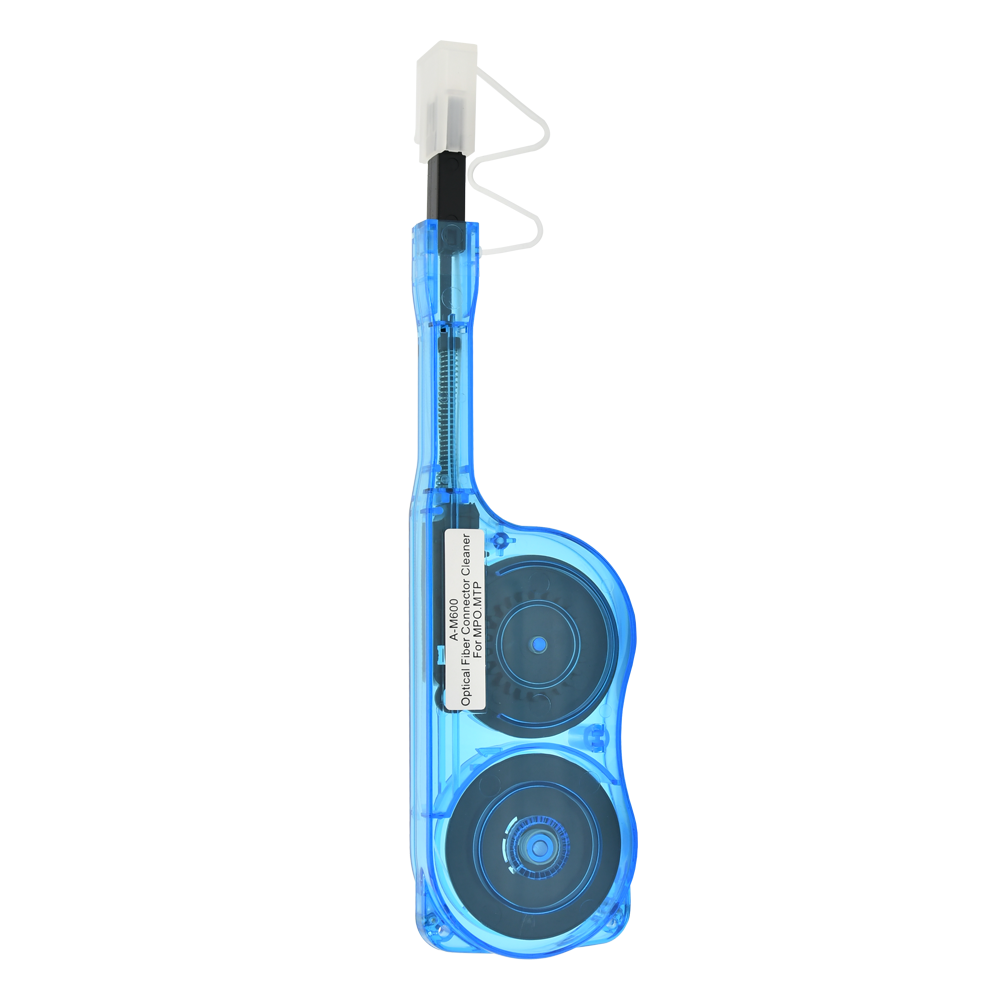
Connector Protection: Avoid contact or scratching of the connector end face with objects, and use specialized cleaning tools to maintain a clean end face.
Cable Management: Maintain a bending radius of ≥20 times the outer diameter, and ensure appropriate tightness when bundling cables to prevent cable damage or breakage.
Standard Compliance: Adhere to international standards such as TIA/EIA to ensure connection quality and compatibility.